The Google Ngram Viewer is a phrase-usage graphing tool which charts the yearly count of selected n-grams (letter combinations), words, or phrases, as found in over 5.2 million books digitized by Google Inc (up to 2008). The words or phrases (or ngrams) are matched by case-sensitive spelling, comparing exact uppercase letters, and plotted on the graph if found in 40 or more books. The Ngram tool was released in mid-December 2010.
The word-search database was created by Google Labs, based originally on 5.2 million books, published between 1500 and 2008, containing 500 billion words in American English, British English, French, German, Spanish, Russian, or Chinese. Italian words are counted by their use in other languages. A user of the Ngram tool has the option to select among the source languages for the word-search operations.
When you enter phrases into the Google Books Ngram Viewer, it displays a graph showing how those phrases have occurred in a corpus of books (e.g., “Halifax”, “Nova Scotia”) over the selected years.
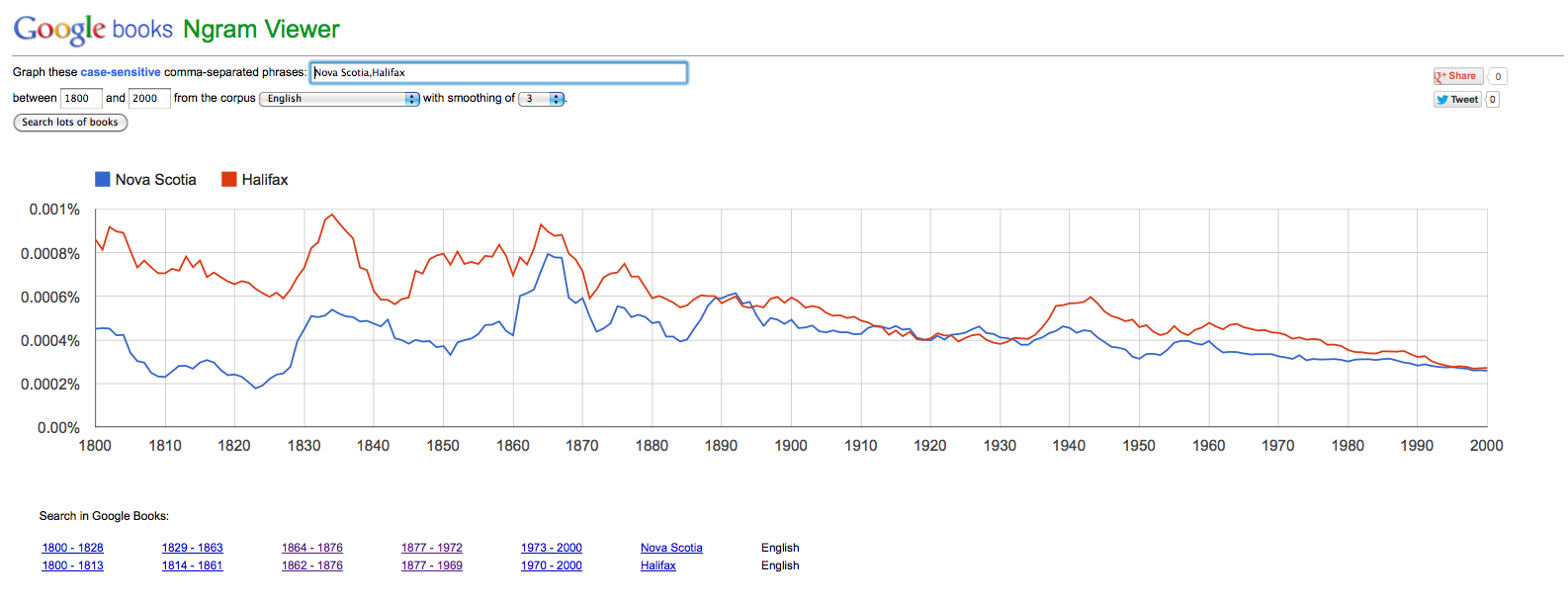
Clicking on the year will give you the list of books that Google has scanned and in some cases are fully downloadable.
Google has some more explanation of what the trends are. I found this to be a bit heavier in info than I needed.
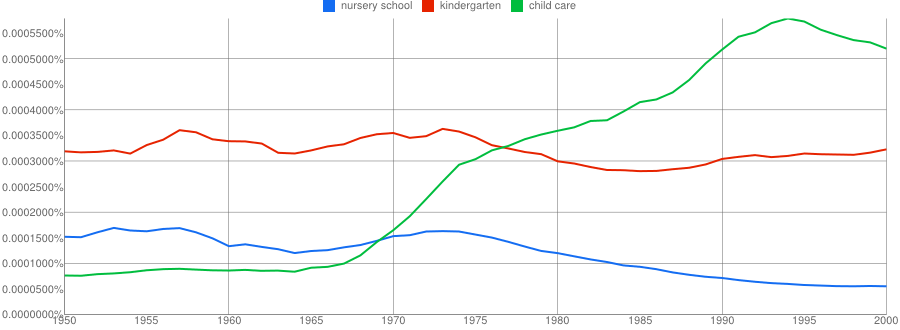
This shows trends in two ngrams from 1800 to 2000: “nursery school” (a 2-gram or bigram), “kindergarten” (a 1-gram or unigram), and “child care” (another bigram). What the y-axis shows is this: of all the bigrams contained in our sample of books written in English and published in the United States, what percentage of them are “nursery school” or “child care”? Of all the unigrams, what percentage of them are “kindergarten”? Here, you can see that use of the phrase “child care” started to rise in the late 1960s, overtaking “nursery school” around 1970 and then “kindergarten” around 1973. It peaked shortly after 1990 and has been falling steadily since.
Recent Comments